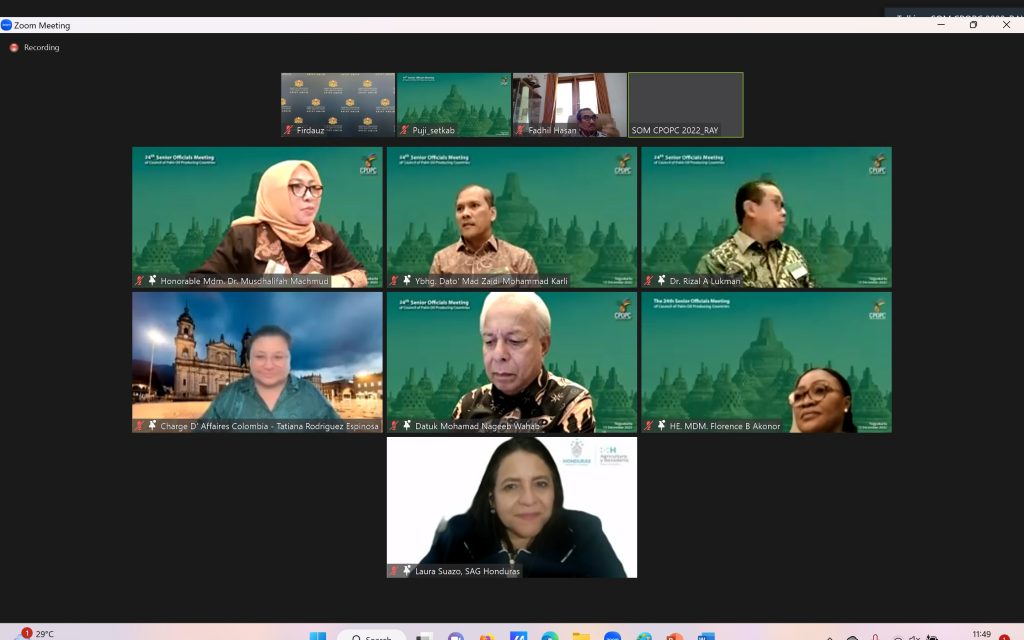
The 24th Senior Officials Meeting (SOM) of the Council of Palm Oil Producing Countries (CPOPC) was held on 15 December 2022 in a hybrid format at the Royal Ambarrukmo in Yogyakarta, Indonesia. The main objectives of the meeting were for the Council to highlight the key activities since the last SOM, as well as for the SOM leaders to review the outcomes and strategize the milestones going forward especially in relation to the upcoming year’s work plan and budget.
The meeting was co-chaired by Hon. Dr. Musdhalifah Machmud, Deputy Minister for Food and Agribusiness, Coordinating Ministry for Economic Affairs, the Republic of Indonesia and YBhg Dato’ Mad Zaidi bin Mohd Karli, Deputy Secretary General (Plantation & Commodities), Ministry of Plantation and Commodities, Malaysia.
In her opening remarks, Hon. Dr. Musdhalifah Machmud, reiterated the importance of palm oil for the social, economy, and environment, and the roles of CPOPC to address the challenges revolving this industry and to submit a more significant contribution of palm oil sector to global recovery that is strong, inclusive, and sustainable.
YBhg Dato’ Mad Zaidi Mohd Karli pointed out that CPOPC needs to gather more palm oil producing countries as full-fledged members to strengthen its role in championing the oil palm sector. Moreover, CPOPC should consider out of the box actions, such as engaging NGO’s and social influencers with strong base for a positive campaign and buzzworthy effects.
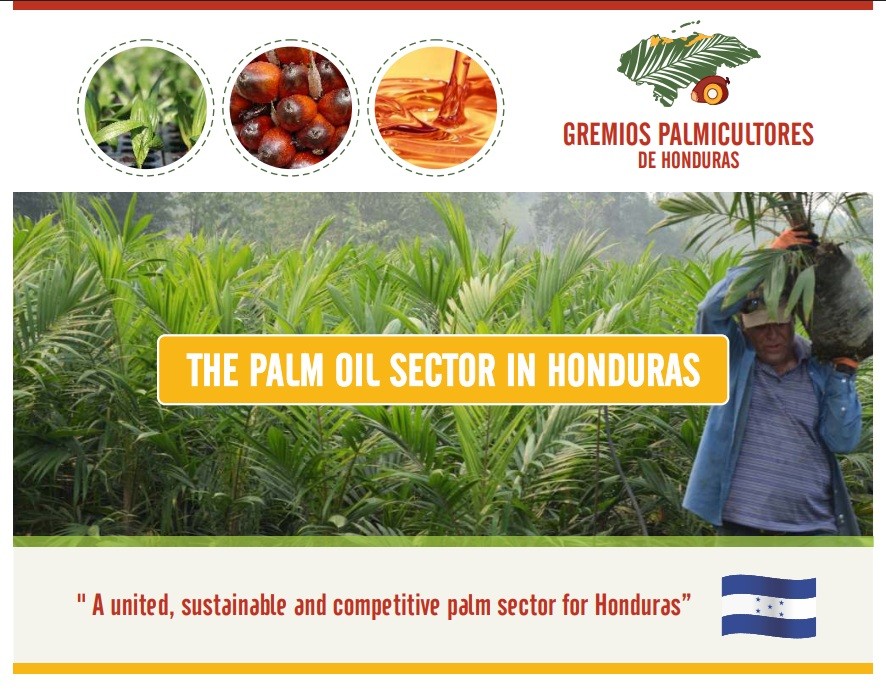
The meeting was also attended by high-level representatives from observer countries namely Colombia, Ghana, Honduras, and Papua New Guinea as well as the Secretary-General and the Secretariat of CPOPC. In their remarks, the representatives of observer countries affirmed their commitments to be full-fledged members soonest possible.
SOM leaders emphasised the importance for greater cooperation among palm oil producing countries in making the industry in a stronger position going forward. The recent vegetable oils crisis revealed the volatility of the market in terms of supply and demand. This led the commodity traders turning their focus again to palm oil, the most affordable and most abundant vegetable oil. CPOPC should leverage this momentum to highlight that smear campaigns and sustainability criticism against palm oil is inaccurate and baseless.
SOM leaders took note of the current development related to the legislation in the EU that have negative implications on the oil palm industry including its impacts on the smallholders. The SOM deliberated the action plans in addressing the issues of common interest. One key action plan is engagements with the relevant stakeholders in the EU including policy makers, non-governmental organisations (NGOs), companies and consumers. CPOPC also intends to engage individual EU Member States in getting the recognition of national mandatory certification schemes including the Indonesian Sustainable Palm Oil (ISPO) and Malaysian Sustainable Palm Oil (MSPO).
In view of the latest development, SOM leaders affirmed the need to refocus the roles of CPOPC. The five focused areas of CPOPC are promotion and advocacy; consultation and collaboration; research and development (R&D) and training; smallholders; and sustainability. Thus, CPOPC will be a platform geared towards integrating, facilitating, and bridging the global palm oil stakeholders on issues of common concern. CPOPC can be a hub for global palm oil campaigns and engagements beyond national or bilateral settings.
CPOPC also set an important milestone in strengthening the organizational framework following the completed ratification of the Protocol to Amend the CPOPC Charter by member countries, which allows the amendment to come into force. A total of 46 clauses covering 15 articles were amended. The initiative to amend the Charter of Establishment of CPOPC took into account the need to form a solid basis for future direction of the Council, especially in making CPOPC visible, relevant and effective.
CPOPC continues to support R&D studies under the guidance and advice of the Scientific Committee. More importantly, the coordination by CPOPC enable the optimisation of resources and to avoid duplication of research programs in palm oil producing countries.
CPOPC over the nine months had conducted numerous activities to promote the goodness of palm oil as well as to address the negative perception and the emerging issues raised by consumer countries. For example, CPOPC initiated the Sustainable Vegetable Oils Conference which was conducted for the first time ever that covers all edible oils. Impact of CPOPC’s activities has given positive results e.g., the reduction of ‘no palm oil’ labelling in most consuming countries.
Another CPOPC’s initiative is the establishment of the Global Framework of Principles for Sustainable Palm Oil to align the principles and criteria of the current available certification schemes.
The meeting agreed to hold the forthcoming 25th SOM back-to-back with the 11th Ministerial Meeting of CPOPC in Malaysia. Malaysia will hold the CPOPC Chairmanship from 1 January 2023 for one calendar year.