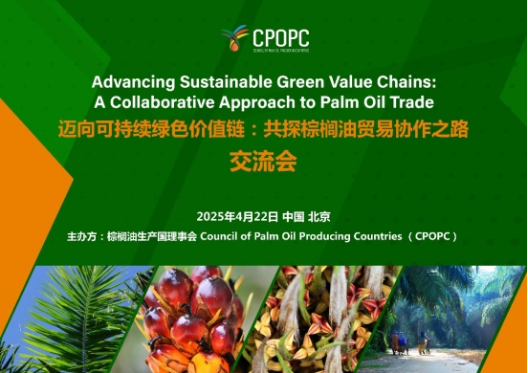
Strengthen cross-sectoral cooperation to jointly promote the sustainable development of palm oil trade
The Council of Palm Oil Producing Countries delegation visits China for the first time
Recently, a delegation from the Council of Palm Oil Producing Countries (CPOPC), an intergovernmental organization comprised of major palm oil producing countries, held its first luncheon in Beijing. Representatives from government departments, industry associations, sustainable development organizations, and businesses from various countries gathered to discuss sustainable development paths for the palm oil value chain.
The conference, themed "Towards a Sustainable Green Value Chain: Exploring Collaborative Paths in Palm Oil Trade," discussed the important role of palm oil trade in the global economy and how it can be aligned with China's sustainable development strategy. Participants exchanged views on core issues such as improving supply chain transparency, addressing market challenges, and promoting green consumption.
The Council of Palm Oil Producing Countries (CPOPC) is an intergovernmental organization of palm oil producing countries, established by Indonesia and Malaysia on November 21, 2015. The Council aims to promote, develop, and strengthen cooperation among member countries in the oil palm plantation and industry sectors, thereby ensuring that palm oil-related industries contribute to the long-term economic development, environmental progress, and social well-being of member countries. Currently, full members of the CPOPC include Indonesia, Malaysia, Honduras, Papua New Guinea, and the Democratic Republic of Congo. Colombia, Ghana, and Nigeria are in transitional observer status and will become full members in the future.
As one of the world's most widely used vegetable oils, palm oil accounts for approximately 40% of global edible oil production. The eight member and observer countries of the CPOPC together account for 88.8% of global palm oil production, supporting millions of jobs. In response to the global demand for sustainable agricultural products, producing countries have achieved significant results in sustainable development.
“Sustainable development is our firm commitment,” said Dr. Rizal Affandi Lukman, Secretary General of CPOPC. “By implementing the Principles of the Global Framework for Sustainable Palm Oil, we are promoting industry standardization and helping growers adopt environmentally friendly production methods. The palm oil industry is not only an economic growth engine, but also a platform for green innovation.”

Dr. Rizal Afandi Lukman, Secretary General of the Council of Palm Oil Producing Countries
As the world's second-largest importer of palm oil and the second-largest consumer after India, China plays a crucial role in promoting sustainable trade. Last November, the China Chamber of Commerce for Foodstuffs and Native Produce (CPOPC), the China Chamber of Commerce for Foodstuffs and Native Produce, and the Beijing office of the World Resources Institute (WRI) signed a Memorandum of Understanding on strengthening sustainable cooperation between China and palm oil producing countries. Building on this foundation, this meeting provides an important opportunity for China and CPOPC member countries to further deepen cooperation. Both sides will conduct more practical cooperation in areas such as building sustainable supply chains and developing a green economy. Cao Derong, President of the China Chamber of Commerce for Foodstuffs and Native Produce, stated that in today's world where environmental protection and sustainable development have become a global consensus, the palm oil industry also faces new challenges and opportunities. "The Chamber of Commerce is well aware of the importance of this trend and is cooperating with organizations such as CPOPC and WRI to develop sustainable palm oil procurement standards and guidelines for China, encouraging enterprises to follow advanced international sustainable palm oil standards and advocating for Chinese enterprises to actively participate in the sustainable palm oil cause."
Dr. Fang Li, Chief Representative of WRI China, stated that the World Resources Institute is committed to promoting practical solutions that align economic growth with sustainable development, and the palm oil industry is precisely an area that urgently needs such alignment and possesses high feasibility. "We are fully prepared to provide more in-depth research findings, practical tools, an open dialogue platform, and efficient collaboration mechanisms to support active participation from all stakeholders, achieve cross-sectoral consensus, and promote effective market integration."
Bukti Bagja, Senior Manager of Supply Chain and Livelihood Transformation at WRI Indonesia, pointed out that in recent years WRI has collaborated with major stakeholders in Indonesia's palm oil industry to jointly promote sustainable palm oil production, trade, and financing between Indonesia and China. Specific measures include accelerating policy implementation, providing technical assistance to smallholder farmers and the private sector, conducting research and innovation, and promoting the application of environmentally friendly technologies.
With the continued growth of green consumption demand in China and the deepening of the "dual-carbon" strategy, palm oil has broad application prospects in the environmental protection field. "China's leading advantage in low-carbon development has created favorable conditions for the integration of sustainable palm oil into the industrial chain," said Luckman in a media interview. He added that for a long time, some misunderstandings about the health risks of palm oil and palm tree cultivation have affected its promotion. In fact, palm oil, like other edible oils, has its own health benefits and drawbacks. For some time, the high saturated fatty acid content of palm oil (up to 50%) has caused health problems due to the view that "excessive intake of saturated fatty acids increases the risk of cardiovascular disease." However, saturated fatty acids are naturally present in various foods, and their resistance to oxidation makes palm oil more suitable for high-temperature cooking such as frying, which also leads to its widespread use in the food industry.
According to Lukman, China needs approximately 6 million tons of palm oil annually, and due to a lack of domestic production, it relies almost entirely on imports. About 50% of this palm oil is used in the food industry, with the remainder used in pharmaceuticals and cosmetics. Furthermore, thanks to the continuous efforts of major producing countries, palm oil production now aligns with sustainable development principles. Currently, Indonesia and Malaysia have implemented mandatory sustainable certification programs, including Indonesian Sustainable Palm Oil (ISPO) and Malaysian Sustainable Palm Oil (MSPO).
It's worth noting that, with technological advancements, palm oil and petroleum have converged, with palm oil emerging as a new energy source for biodiesel. "The Indonesian government is committed to increasing the blending ratio of biodiesel, and this year plans to mandate an increase in the palm oil content in diesel from the current 35% to 40%; Malaysia is also pushing for similar programs, such as B7, which requires a biodiesel blending ratio of over 7%," said Lukman. "This year we consumed nearly 13 million tons of palm oil for biodiesel blending," said Harjanto Hanawi, vice president of the Indonesian Palm Oil Association.
“The situations in producing and consuming countries can influence each other,” Lukman explained. On the one hand, the situation in producing countries affects consuming countries; for example, delays in replanting projects implemented by some producing countries have led to reduced palm oil production, and biodiesel blending projects may cause changes in palm oil exports. On the other hand, the production of other vegetable oils within consuming countries also affects palm oil imports and exports. Furthermore, the current international situation has led to reduced production of other vegetable oils, including sunflower oil and rapeseed oil, resulting in higher palm oil prices. “CPOPC looks forward to strengthening cooperation with its Chinese partners to jointly promote sustainable development in the industry and enhance consumer awareness.”
The meeting reached a consensus that all parties will strengthen cross-sectoral cooperation, expand the scale of sustainable practices, and achieve a win-win situation for economic development and ecological protection. It is understood that during their stay in Beijing, the CPOPC delegation also held several meetings with relevant institutions to conduct in-depth exchanges on topics such as promoting the sustainable development of the palm oil industry and expanding cooperation in the green economy.
Recent Pressroom