The sustainable path of palm oil: traceable from the source to the carbon footprint certification of the industrial chain
Palm oil producers and consumers work together to address new challenges to sustainability in global supply chains.
In April this year, the Council of Palm Oil Producing Countries (CPOPC), an intergovernmental organization composed of major palm oil producing countries, visited China to discuss the sustainable development path of the palm oil supply chain.
CPOPC was initiated by Malaysia and Indonesia, the two largest palm oil producers in the world, accounting for more than 80% of the world's palm oil production.
The official visit is the first since the council's inception in 2015, and they hope to strengthen cooperation with China to jointly respond to the EU's unilateral EU Deforestation Regulation (EUDR). The bill puts forward a series of strict requirements for palm oil product traceability, corresponding certification and geographical location, etc., which poses great challenges for palm oil producing countries.
As the world's second-largest importer of palm oil, China plays a key role in supporting inclusive and sustainable trade. China's leading edge in low-carbon development has laid a good foundation for the integration of sustainable palm oil into the industrial chain, and CPOPC looks forward to strengthening cooperation with Chinese partners to jointly promote the sustainable development of the industry.
Sustainable palm farming
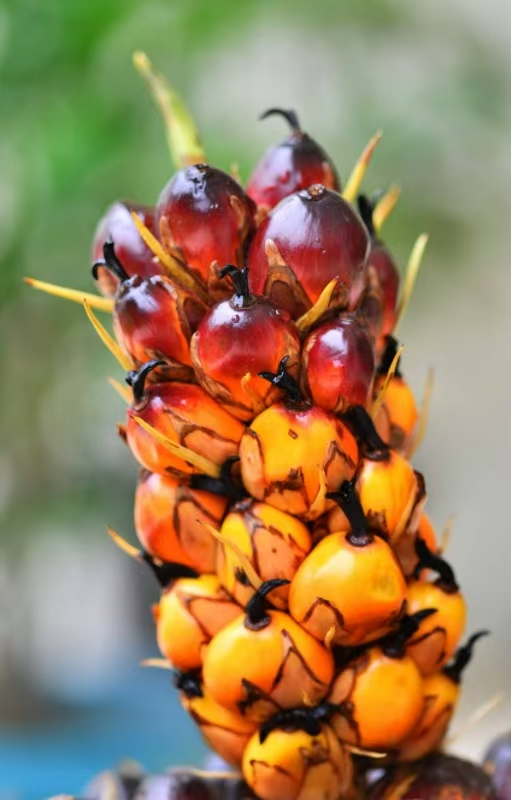
Palm oil is the most widely used vegetable oil in the world, accounting for about 40% of the world's total edible oil production. The five CPOPC member countries and observer countries together account for 84% of the world's palm oil production.
Sustainability is our strong commitment, and among palm oil producing countries, Indonesia and Malaysia, for example, are taking measures to reduce the rate of primary forest damage while focusing on production growth.
In Indonesia, there is Indonesian Sustainable Palm Oil (ISPO), which is the Indonesian Sustainable Palm Oil certification standard. In Malaysia, there is also a Malaysian Sustainable Palm Oil (MSPO) certification standard. The certification process of ISPO and MSPO is almost the same, they mainly have seven principles, consisting of more than 120 standards. Both standards are mandatory and must be met by all businesses, plantations and smallholder farmers involved in the palm oil production process. These certification systems aim to establish sustainable practices in the palm oil industry, most importantly protecting the natural environment.
Therefore, CPOPC officially released the Global Framework Principles for Sustainable Palm Oil (GFP-SPO). The framework is based on ISPO, MSPO and Palm Oil Sustainability Roundtable Certification (RSPO) to build a unified certification benchmark system for the global palm oil industry. GFP-SPO provides a paradigm reference for the development of localized certification systems for other major producing countries, helping countries improve their governance frameworks according to their own national conditions. The council hopes that through this mechanism innovation, the construction of international industry standards and the transformation of ecological production for growers will be coordinated, and finally the dynamic balance between industrial development and ecological protection will be realized. Businesses and smallholder farmers alike, Indonesia and Malaysia are doing a lot of work to meet sustainable development, which is also a good learning process for other countries to develop their supply chain traceability systems.
By establishing a diversified sustainable certification system and standards, countries involved in the oil palm industry can ensure the protection of forests and the ecological environment, and promote palm oil production in line with sustainable principles. In Malaysia, for example, the government has set a target of keeping at least 50% of the country's land area covered by forests, and the current actual coverage rate has reached 55.3%. In addition, the government has committed to limiting the total area of palm oil cultivation to 6.5 million hectares, and the expansion is limited to degraded land and brownfield sites. This initiative underscores Malaysia's strong commitment to the sustainability of the palm oil industry and biodiversity conservation.

Indonesia has also introduced a series of policies to promote sustainable practices and strengthen environmental protection. In 2018, the Indonesian government suspended the issuance of new palm oil plantation permits to curb deforestation and land-use conflicts, ensuring sustainable management of existing plantations before expansion. Although the ban expired in 2019, the Indonesian government subsequently implemented stricter land use regulation measures. For example, when applying for an extension of a plantation license, an enterprise must allocate 20% of the land to local smallholder farmers; If the application is extended again, this percentage needs to be increased to 30%. The policy aims to promote inclusive development, avoid the monopoly of corporate-led cooperatives, and ensure that independent smallholder farmers can share in the fruits of development.
Green procurement
China's palm oil is mainly used in the food processing industry, of the total import of 6 million tons, more than 3 million tons are used in the food industry, and the other 2 million tons are used in other industries (including cosmetics, and other processing industries), so the approximate composition is that more than 50% of palm oil is used for food processing, and another 2 million tons of palm oil (more than 40%) are used for other industrial processing

The EUDR bill unilaterally proposed by the European Union puts forward a series of requirements for the traceability of palm oil products, corresponding certification and geographical location information, and "zero deforestation". These stringent standards pose significant challenges to producing countries such as Indonesia and Malaysia, as well as consuming countries such as China. In view of the fact that China needs to import palm oil from Indonesia and Malaysia for reprocessing and export to the EU market, in fact, China also needs to indirectly comply with EUDR regulations.
Based on this, palm oil producing countries are expanding cooperation and communication with China, hoping to strengthen coordination and dialogue with China in sustainable development work to ensure that the actions of producers and consumers can be coordinated.
For some consuming countries, palm oil may only need to meet certain standards, but countries are constantly adjusting their own standards to meet sustainability, so for producing and consuming countries, we should work together to ensure that both sides can meet this sustainability standard. While ensuring sustainability, the regulatory requirements of diversification in consumer countries are increasing the burden on producers, especially small farmers.
In addition to the new standards proposed by the EU, how to make the supply chain traceable to ensure that every link of the supply chain can meet sustainable standards is also the focus of all parties. In this context, producing and marketing countries urgently need to recognize the sustainable development achievements of producing countries through international cooperation and avoid unilaterally imposing additional requirements by economies such as the European Union. In view of this, CPOPC took the opportunity of visiting China to bring together government officials, industry leaders and key stakeholders to explore cooperation paths for sustainable palm oil value chains, and signed a memorandum of cooperation with the China Chamber of Commerce for Import and Export of Food, Soil and Livestock and the World Resources Institute (WRI) China Office to strengthen the sustainable cooperation mechanism between China and oil-producing countries. On this basis, the two sides ushered in an important opportunity to deepen cooperation, and will jointly promote the construction of green supply chains and cultivate green economic momentum.
In order to implement its strategic goals, CPOPC also hosted a series of international conferences on sustainable vegetable oils to build a dialogue platform for major vegetable oil producing countries around the world. The conference focused on industry challenges in the context of climate change, regulatory pressures, and growing demand. The high-level forum "Building Sustainable Green Value Chains: A Synergistic Path to Palm Oil Trade" held in China at the same time highlighted the key position of the palm oil industry in global trade and its potential to align with China's Sustainable Development Goals.
Eliminate misconceptions
Compared to other vegetable oils, palm oil faces accusations of the environment, forced labor, and health. Therefore, there is an urgent need to promote the health benefits of palm oil to combat these negative claims. One country alone is not enough to dispel these misconceptions. Therefore, strong cooperation between major producers and consumers is essential to combat misinformation about palm oil.
Palm oil contains a variety of health-promoting nutrients, such as it is rich in tocotrienols, vitamin E, which helps prevent cancer and cell damage, and regulates the immune system, among others, but people are prejudiced against palm oil because of its higher saturated fat content, believing that it raises blood cholesterol, thereby increasing the risk of cardiovascular disease.
However, a growing body of scientific evidence suggests that there is no close link between saturated fat intake and cardiovascular disease, prompting scientists to further explore this topic. For example, a 2010 comprehensive analysis of nearly 350,000 participants did not find an association between saturated fat intake and the risk of coronary heart disease, stroke, or cardiovascular disease.
A paper published in 2017 by researchers from the Advanced Training Institute of the State Food and Drug Administration (SFDAIED) and China Agricultural University came to a similar conclusion that "there is little or no association between saturated fat intake, represented by palm oil, and cardiovascular disease."
Some views claim that palm oil produces toxic or carcinogenic substances when cooked at high temperatures, but the phenomenon of harmful substances caused by high-temperature heating is not unique to palm oil. Studies have shown that all vegetable oils can form harmful compounds during repeated high-temperature heating, and there is no basis for such doubts about palm oil alone. Conversely, palm oil's thermal stability and natural nutrient composition make it a relatively healthier option for high-temperature cooking scenarios, especially compared to oils prone to oxidative reactions.
Of particular note is that red palm oil is rich in natural carotenoids (provitamin A), which can contain up to 15 times more β-carotene than carrots, which has significant benefits for maintaining visual health and immune function. Except for artificial fortifications, most vegetable oils do not have this natural carotenoid.
Collaborate to address new challenges to global supply chain sustainability
Today, when environmental protection and sustainable development have become a global consensus, the palm oil industry is also facing new challenges.
The EUDR Act puts forward a series of requirements for the traceability of palm oil products, corresponding certifications and geographical location information, etc., including the relevant policies of "zero deforestation". This policy is highly demanding for producing countries. This policy will have a great impact not only on palm oil producers such as Indonesia and Malaysia, but also on China, which imports palm oil for reprocessing and then exports it to Europe.
The EUDR bill will have an impact on China's exports, because the bill covers not only palm oil, but also forestry products, timber products, and other palm oil products. This is why palm oil producers and consumers need to cooperate. Indonesia and Malaysia export large quantities of palm oil to China for use as raw materials for food processing and cosmetics processing. These final products from palm oil processing are sold to the European market and are subject to EUDR regulation. Coordinating with Chinese policymakers can help China ensure that palm oil products purchased from Indonesia and Malaysia are EUDR compliant, thereby ensuring that Chinese palm oil products are produced to meet EU standards.
China is an important consumer of palm oil and is now sourcing palm oil products from Malaysia and Indonesia in accordance with sustainable sourcing principles.
Indonesia and Malaysia have made a lot of preparations and actions to enable them to adapt and meet these global needs. The European Union, China, India, ASEAN, Japan, and South Korea have all increased their demand for sustainable palm oil products, and Indonesia and Malaysia have made significant preparations and actions to enable both countries to adapt and meet these global needs.
In 2004, the RSPO standard was introduced to Indonesia, and 20%-25% of Indonesia's palm oil production has been certified by RSPO. In 2011, the Indonesian government promulgated the ISPO certification standard, which (as of now) more than 50% of Indonesia's production has passed, which means that half of the companies can complete this certification. By 2019, Indonesia had launched a nationwide program to promote the sustainability of the palm oil industry. As of December 31, 2024, 4.89 million hectares of palm oil planting areas in Malaysia have been awarded MSPO, accounting for 86.47% of the country's total palm oil cultivation area, demonstrating Malaysia's strong commitment to sustainable development.
Sustainable cooperation between China and palm oil producers has been further strengthened through the memorandum of understanding signed by CPOPC, the China Chamber of Commerce for Import and Export of Food, Soil and Livestock and the World Resources Institute. The two sides will carry out more practical cooperation in the fields of building a sustainable supply chain and developing a green economy. The China Chamber of Commerce for Import and Export of Food, Soil and Livestock highly recognizes the importance of this cooperation, and the World Resources Institute is working with the Council to develop sustainable palm oil sourcing standards and guidelines for China. In view of this, the Council encourages enterprises to adopt advanced international sustainable palm oil standards and advocates Chinese enterprises to actively participate in the development of the sustainable palm oil industry.
Recent Pressroom