Press Release 4th SVOC in Shanghai Puts Innovation and Resilient Vegetable Oil Supply Chains in the Spotlight
The Conference brings together producing and consuming countries representing 11 countries to explore sustainability, innovation, green trade, and stronger supply-chain cooperation.
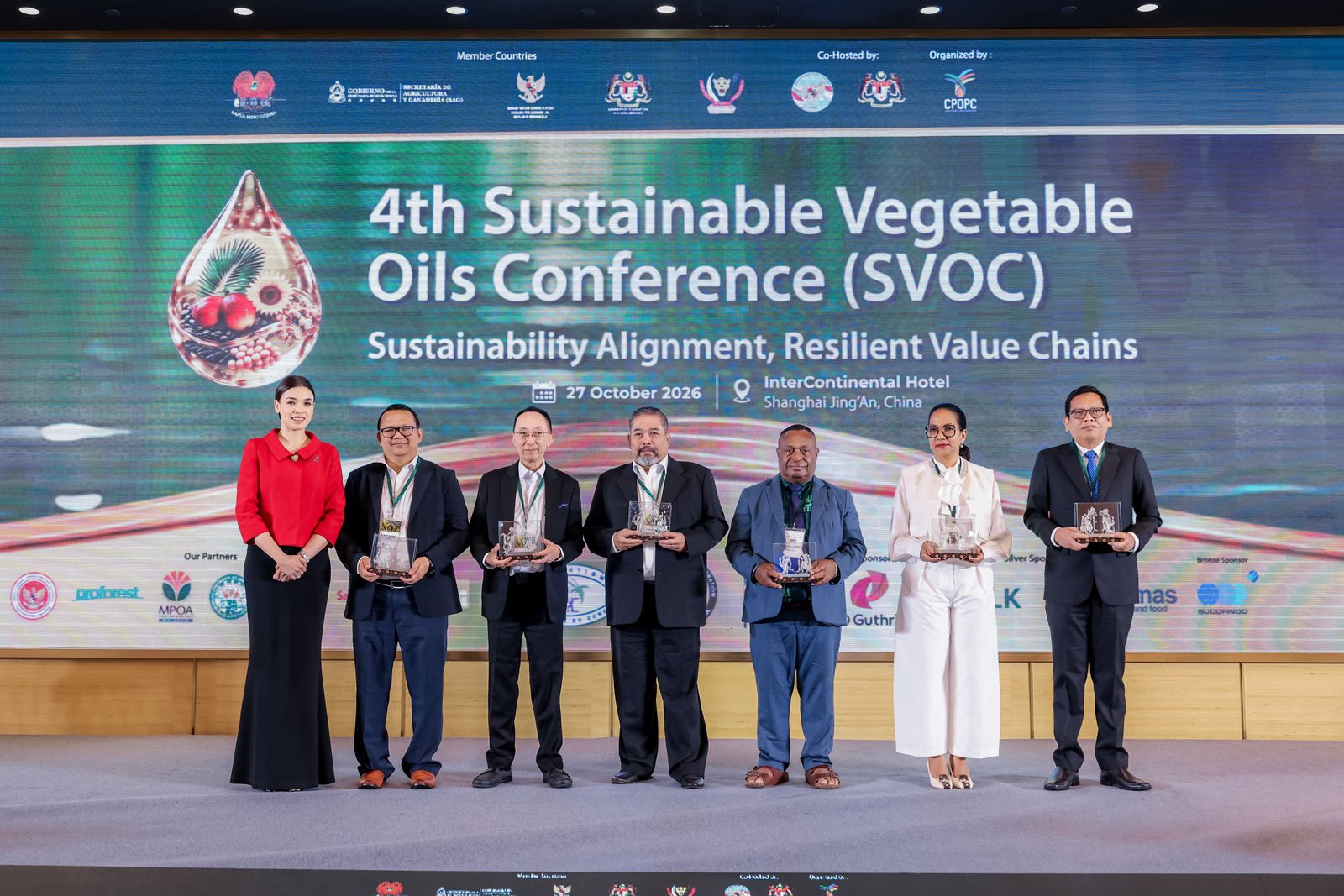
Shanghai, 27 October 2026 - The Council of Palm Oil Producing Countries (CPOPC) convened the 4th Sustainable Vegetable Oils Conference (SVOC) at the InterContinental Hotel Shanghai, under the theme of “Sustainability Alignment, Resilient Value Chains”. Organised by CPOPC and co-hosted with the Embassy of the Republic of Indonesia and the Embassy of Malaysia, the Conference was held for the first time in China, following earlier editions held in Indonesia, India and the Netherlands.
The Conference has attracted registrations from 270 participants representing 11 countries, bringing together government officials, industry representatives, international organisations and technical experts across the palm oil, soybean, rapeseed, sunflower and other vegetable oil sectors. Participants discussed how producing and consuming countries can respond to growing demands for efficiency, transparency and verifiable sustainability while maintaining productivity and competitiveness. The discussions also explored opportunities for greater cooperation in innovation, green trade and low-carbon development.
Global vegetable oil production is estimated to reach approximately 234 million tonnes in 2026, with palm oil accounting for around 85 million tonnes, or more than one-third of global output. Although palm, soybean, rapeseed and sunflower oils differ in their production systems and market characteristics, the conference discusses how they are closely interconnected through global trade, pricing, substitution and evolving food and industrial demand. Their representatives of the producers also shared face common challenges related to land use, climate resilience, sustainability standards and market access. These shared interests highlight the importance of exchanging knowledge, strengthening dialogue and pursuing practical cooperation to build more sustainable and resilient vegetable oil value chains.
China plays a vital role in the global vegetable oil market, both as a major consumer and as a strategic partner in trade, technology and innovation. In 2025, China’s vegetable oil consumption was estimated at 35.8 million tonnes, including approximately 5.07 million tonnes of palm oil. These figures underscore the importance of closer cooperation between producing and consuming countries to strengthen sustainable, competitive and resilient vegetable oil supply chains.
In her opening remarks, Madam Izzana Salleh, Secretary-General of CPOPC, emphasised the importance of practical cooperation between producing and consuming countries in addressing evolving sustainability and market expectations.
“Changes in relative prices can shift purchasing decisions between oils, while regulatory uncertainty can affect trade flows and investment confidence. Resilience therefore requires reliable market information, diversified trading relationships, efficient logistics and predictable policy frameworks. It also requires closer engagement between producers and buyers, so that supply commitments, sustainability expectations and commercial incentives are better aligned,” she said.”
The opening segment featured special addresses addressing Shanghai's role in green trade and international cooperation, as well as the implications of a shifting geopolitical landscape for global vegetable oil trade and supply-chain resilience. Keynote addresses by representatives of CPOPC Member Countries reinforced the importance of sustainable production and international cooperation. H.E. Airlangga Hartarto, Coordinating Minister for Economic Affairs of Indonesia, emphasised improving smallholder productivity without expanding plantation areas, while YB Datuk Seri Dr. Noraini Ahmad, Malaysia’s Minister of Plantation and Commodities, called for sustainability standards that support rather than hinder producers’ access to global markets, alongside deeper cooperation with China in technology, research and market development. Mr. José Francisco Ordóñez, Vice Minister of Coffee Cultivation of Honduras, highlighted the importance of demonstrating sustainability through credible traceability systems and strengthening cooperation among China, CPOPC and Latin American countries.
Advancing Sustainability through Productivity and Innovation
The first thematic session, “Driving Sustainability through Productivity and Innovation,” examined how agricultural technologies, improved planting materials, mechanisation, precision agronomy and sustainability standards can support more efficient and responsible vegetable oil production. The session also highlighted China's role in facilitating sustainable vegetable oil trade, improving market access and strengthening supply-chain transparency across different vegetable oil commodities.
The session opened with introductory remarks by H.E. Djauhari Oratmangun, Ambassador of the Republic of Indonesia to China, and brought together industry leaders and sustainability experts to explore innovative approaches to sustainable vegetable oil production. Key speakers included Mr. Mohd Hasbollah Suparyono of Malaysian Sustainable Palm Oil (MSPO); Dr. Chen Zi Yan of Kuala Lumpur Kepong Berhad (KLK); Ms. Caroline Xu of AAK China, Ms. Chen Ying of the China Customs Brokers Association, and Mr. Harry Hanawi of Sinar Mas Agribusiness and Food. The session was moderated by Mr. Lifeng Fang of the Roundtable on Sustainable Palm Oil (RSPO), with Ms. Yu Xin of WWF China serving as lead discussant.
Building Competitive and Resilient Vegetable Oil Value Chains
The second session, “Building Competitive and Resilient Vegetable Oil Value Chains amid Evolving Policies, Standards and Market Demand,” examined how shifting green policies, regulatory frameworks, and market requirements impact both producing and consuming nations. Discussions highlighted China's role in green trade and responsible sourcing, Indonesia's B50 biodiesel policy, and Malaysia’s advancement of palm-based biofuels for a low-carbon economy. Participants also explored the Democratic Republic of the Congo's (DRC) efforts to build resilient palm oil value chains, alongside Papua New Guinea’s strategies to support smallholders through infrastructure and replanting initiatives.
This session brought together government representatives, industry leaders and experts from China and CPOPC Member Countries. Key speakers included Mr. Wang Xin of China’s Foreign Environmental Cooperation Center (FECO), Ministry of Ecology and Environment; Ms. Yang Junyi of World Resources Institute China; Dr. Dadan Kusdiana, Secretary General of Indonesia’s National Energy Council; and Dr. Mohd Hefni Rusli, Deputy Director General (R&D) of the Malaysian Palm Oil Board (MPOB). Perspectives from other producing countries were shared by Hon. Monique Gieskes, CEO of Plantations et Huileries du Congo (PHC), Democratic Republic of the Congo, and Hon. Kepson Pupita, General Secretary of Papua New Guinea’s Oil Palm Industry Corporation (OPIC). Ms. Li Sifan of the China Chamber of Commerce of Import and Export of Foodstuffs, Native Produce and Animal By-products (CFNA) served as lead discussant and Mr. Langlang Tata Buana of the Proforest highlighted how policies and standards shape value chain in practice.
CPOPC will continue to strengthen SVOC as a strategic platform connecting producing and consuming countries, industry, research institutions and sustainability partners, with greater focus on turning dialogue into practical cooperation.
Future editions will also support broader collaboration towards more sustainable and resilient vegetable oil value chains and a stronger global palm oil alliance grounded in evidence, science and constructive dialogue.
Recent Pressroom